1986年4月26日,现在属于乌克兰的切尔诺贝利核反应堆4号反应炉爆炸。这场历史上最大规模的民用原子能爆炸导致了大规模撤离和长期的健 康、农业和经济创伤。附近的Pripyat市已经废弃,并设立了半径19 英里的无人区,以防核辐射对居民造成持续的危害。以下是此次灾难的档案照片和一些当地较新的图片。此外,两名对爆炸后果进行了广泛研究的高尚的摄影师也分 享了他们的成果。Diana Markosian证明了两名靠养老金生存的老人Lida和Mikhail Masanovitz还生活在乌克兰被废弃的鬼城Redkovka。 她拍的照片在第13张到第16张。 Michael Forster Rothbarthas广泛地记录了切尔诺贝利附近人们的生活。他拍的照片在第23张到第29张。两人的网站链接可以在下面找到。-- Lane Turner

一张墙上的涂鸦,4月4日摄于鬼城Pripyat,附近的4号反应炉(背景)位于世界上最严重的核灾难所在地,前切尔诺贝利核电站。(Sergei Supinsky/AFP/Getty 照片)
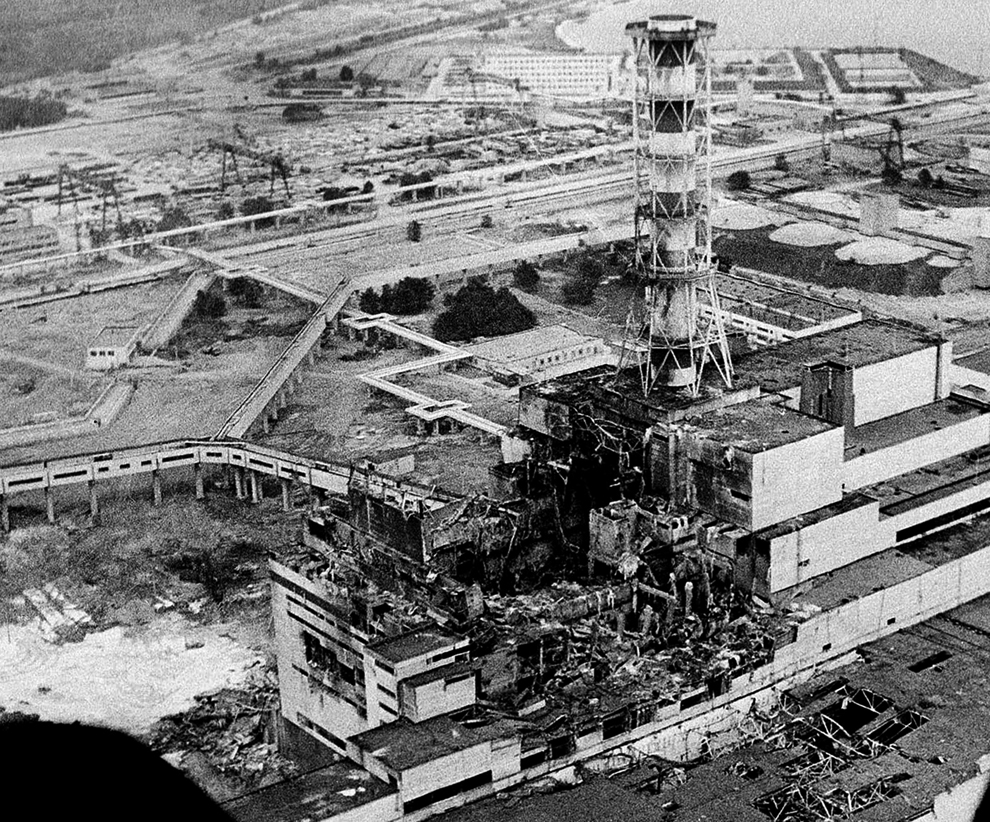
1986年4月乌克兰切尔诺贝利的切尔诺贝利核电站在爆炸后2到3天成为废址。烟囱前的是毁坏的4号反应炉。 (AP)

1986年6月13号,一架直升机在切尔诺贝利核电站附近喷洒辐射净化物。(Reuters/Itar-Tass)

1986年5月15日,一名在切尔诺贝利核电站工作的工程师正在接受Lesnaya Polyana一家疗养院的一名医生的检测,4号反应炉就在几天前爆炸。 (Stf/AFP/Getty Images)

3月16日,人们在位于Kiev的中央政府附近举行集会反对乌克兰将削减“清理者”的社会福利作为一项初步行动,“清理者”是在切尔诺贝利核反应炉灭火的应急工人。(Gleb Garanich/Reuters)

3月23日,乌克兰Donetsk市一名因白血病戴口罩的儿童。Soviet-era工厂爆炸产生的放射性尘埃扩散欧洲的一大批区域,至今仍影响数百万在乌克兰及其周边国家的人。(Alexander Khudoteply/AFP/Getty 图片)#

在荒凉的小镇Pripyat的一座废弃的摩天轮,就在切尔诺贝利核电站附近不到两英里。(Sergey Ponomarev/AP)

4月4日,鬼城Pripyat一家幼儿园里满是灰尘的毒气面具和儿童玩具。(Sergei Supinsky/AFP/Getty Images)

4月4日,鬼城Pripyat一家幼儿园里毫无秩序的床(Sergei Supinsky/AFP/Getty 图片)

在Belarus废弃的Lomysh村,一个男人造访他已变成废墟的房子,此处在切尔诺贝利核反应炉19英里无人区之内。 (Vasily Fedosenko/Reuters)

4月21日,72岁的Natalia Makeenko(左)在废弃的Savichi村拥抱82岁的Galina Shcyuka,不远处就是切尔诺贝利核反应炉半径19英里的无人区。(Viktor Drachev/AFP/Getty 图片)

3月18日,村民们为纪念76岁的Maria Borisenko,在切尔诺贝利核反应炉半径19英里无人区里废弃的Lomysh村聚餐。Borisenko在切尔诺贝利爆炸很多年后撤离了那里,但死 后还是被葬在家乡。(Vasily Fedosenko/Reuters)

74岁的前护士Lida Masanovitz,生长在现在被废弃的乌克兰鬼城Redkovka。她现在领着1000格里夫纳($125)的养老金,尽管住在辐射区,依然没有政府的额外补助。(Diana Markosian/Redux 图片)

Lida Masanovitz在乌克兰鬼城Redkokva的一片田里种洋葱和萝卜。在1986年切尔诺贝利事故后,村民们被要求不要食用自种食品以避免辐射。(Diana Markosian/Redux 图片)

Lida Masanovitz 站在73岁的丈夫MIkhail Masanovitz身旁跟女儿打电话。在1986年4月26日切尔诺贝利事故后Masanovitz的女儿因甲状腺问题而接受治疗。事故后估计有7百万 前白俄罗斯苏维埃共和国、俄罗斯和乌克兰人得了跟辐射有关的疾病,包括甲状腺和血液循环问题。(Diana Markosian/Redux 图片)

Lida Masanovitz和丈夫MIkhail Masanovitz睡在他们家里。50年前两人在现在的鬼城Redkovka相遇。(Diana Markosian/Redux 图片)

2月22日,一名白俄罗斯Tulgovichi村名正在推手推车,附近就是切尔诺贝利核反应炉半径19英里无人区。今天的白俄罗斯边境自从1986年当地人撤离后,已经变成一个怪异的,过度生长的野性世界——野生动物肆意繁殖而人迹罕至。纠缠的树叶下快速逃窜的动物们在那里觅食、安家。曾经有1000居民的Tulgovichi村现在任然居住着少数不愿迁走的靠养老金生活的人。(Vasily Fedosenko/Reuters)

2009年1月11日,一名猎人就在切尔诺贝利核反应炉半径19英里无人区外追逐一只狐狸。1986年核灾难,人们撤离这里后,野生动物们无视辐射级别般的在无人区里以及周围肆意繁殖。(Vasily Fedosenko/Reuters)

2月21日,在Babchin村附近切尔诺贝利核反应炉半径19英里无人区里的生态保护区里,一名工人在喂野牛。 (Vasily Fedosenko/Reuters)

A deer stands in the state radiation ecology reserve in the 19-mile exclusion zone around the Chernobyl nuclear reactor near the village of Babchin, Belarus on March 18. Still inhospitable to humans, the Chernobyl exclusion zone - a contaminated 19-mile radius around the site of the nuclear reactor explosion - is now a nature reserve and teems with different wild animals. (Vasily Fedosenko/Reuters) #

A woman is screened for thyroid cancer by doctors from the Red Cross in the village of Ukrainka, Ukraine on April 19. (Gleb Garanich/Reuters) #

A cancer patient leans against the window of a special treatment chamber in a hospital in Donetsk, Ukraine on April 25, 2006. (Alexander Khudotioply/Reuters) #

Viktor and Lydia Gaidak in their apartment in the Desnyanskiy district at the outskirts of Kyiv, Ukraine on April 27, 2007. Viktor Gaidak worked for 24 years as an engineer at the Chernobyl plant, including nine years after the 1986 accident. In 2004 he had surgery for colon cancer. (Michael Forster Rothbart) #

Olya Podoprigora, 13, and 18-month-old Parvana Sulemanova, recover in the ICU one day after open-heart surgeries in Kharkiv, Ukraine. Both girls had congenital heart defects, and every year, 6,000 children in Ukraine are born with genetic heart disease. Radiation is suspected as the cause, but is not proven. (Michael Forster Rothbart) #

Ornithologist Igor Chizhebskiy holds a nestful of newly hatched chicks on a wooded hilltop above the Chernobyl cooling pond. His research compares birth and survival rates of birds born in highly radioactive sites to those in less contaminated areas within the Zone. Surveys of birds, insects, and spiders by Igor and his colleagues indicate that many species are either absent or exist in very low numbers in the Chernobyl region. The diminished bird populations could be caused by radiation directly or may be due to a decrease in food sources such as insects. (Michael Forster Rothbart) #

Late on a long winter's night, Nina Dubrovskaya and her friend Lena Priyenko walk home to their village Sukachi, Ukraine, from the nearby town of Ivankiv, 2 miles away. The two women, both divorcees, went out to the bars in Ivankiv in search of company, but found all 4 bars they visited nearly empty. "When the money gets short, people just get drunk at home," says Dubrovskaya. Sukachi is a village of 1,200. Half the people of Sukachi are Chernobyl evacuees, relocated here from the abandoned village of Ladizhichi. (Michael Forster Rothbart) #

In Slavutych, Ukraine, a memorial hall in the city museum is dedicated to the Chernobyl accident, with photographs of the men and women who died immediately following the explosion. Former Chernobyl plant worker Sergii Kasyanchuk manages the Chernobyl Information Center museum now that his health no longer allows him to enter the Chernobyl Exclusion Zone. More than half the families in Slavutych have a member who still works at the plant, and everyone knows colleagues who became ill or died due to the Chernobyl accident. (Michael Forster Rothbart) #

Teenage dancers wait backstage for their turn to perform during a Slavutych, Ukraine city concert. Slavutych is the new city built after the accident to house evacuated Chernobyl personnel. The Chernobyl plant once funded many programs in the city. Now the city struggles with decreased resources due to layoffs at the Chernobyl plant. (Michael Forster Rothbart) #

Warning:
This image contains graphic
or objectionable content
click here to view it.
This photograph has been removed. “Mostly, people do not get sick because of radiation. They get sick because they believe they are victims,” says Sergii Mirnyi, a "liquidator" - a Chernobyl emergency worker. Mirnyi rolls in the snow after a sauna in Chernigiv, in February 2009. In 1986, during decontamination efforts, Sergii served as commander of a radiation reconnaissance platoon working directly around the Chernobyl nuclear power plant. An eternal optimist, he now hopes to produce a comedy feature film about the lives of soldiers cleaning up after Chernobyl. Six million people still live in the entire contaminated region, an area of Ukraine, Belarus and Russia covering 56,700 square miles, about 1.2 times the size of New York state. #

A geiger counter shows a reading of the radiation levels in the air by the 4th power block of Chernobyl's nuclear power plant, covered with a "sarcophagus" as it lies derelict on March 31. (Sergei Supinsky/AFP/Getty Images) #

Vehicles contaminated by radioactivity lay dormant on November 10, 2000 near the Chernobyl nuclear power plant. Some 1,350 Soviet military helicopters, buses, bulldozers, tankers, transporters, fire engines and ambulances were used while fighting the nuclear accident. All were irradiated during the clean-up operation. (Efrem Lukatsky/AP) #

Employees of the Polessky State Radiation Ecological Reserve wear facemasks on April 20 as they plant trees on contaminated land near the abandoned village of Bogushi, Belarus, inside the 19-mile exclusion zone around the Chernobyl nuclear reactor, to form a natural windbreak to stop radioactive particles from blowing away. One-fifth of the country's agricultural land was contaminated following the blast at the nuclear reactor and around 70% of the fallout fell in Belarus. (Viktor Drachev/AFP/Getty Images) #

Workers from the State Radiation Ecological Reserve test radiation levels on pigs at a farm in Vorotets, Belarus on April 21, close to the 19-mile exclusion zone around the Chernobyl nuclear reactor. (Viktor Drachev/AFP/Getty Images) #

Schoolchildren wear gas masks during nuclear safety training lessons in Rudo, Ukraine near an isolated zone around the Chernobyl nuclear power plant April 3, 2006. (AP Photo/Sergey Ponomarev) #
|